
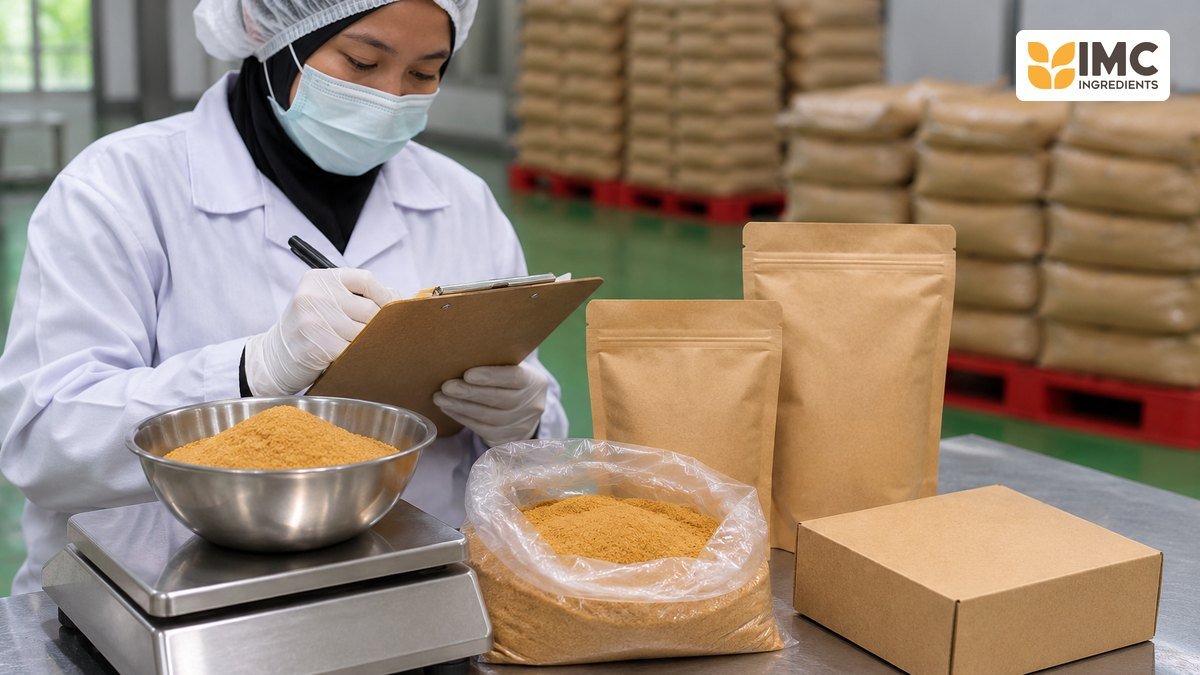
Quick answer: After drying and sieving, coconut sugar is weighed into bags on calibrated scales, sealed inside a food-grade liner, closed, coded with a lot number and stacked for shipment. Accurate weighing, a good seal and clear coding protect the product and make every bag traceable.
Key takeaways – Calibrated scales keep net weights accurate. – An inner liner protects against moisture. – Lot codes make each bag traceable. – Careful stacking prevents damage in transit.
Why packing matters
Coconut sugar takes up moisture from the air. A poor seal can lead to clumping before the sugar reaches the customer. Wrong weights cause disputes and stock errors. Good packing practice protects quality, keeps the customer’s production running and builds trust between supplier and buyer.
The packing steps
| Step | Purpose |
|---|---|
| Final sieving | Correct particle size, foreign matter removal |
| Metal or foreign body check | Product safety |
| Weighing | Correct net weight |
| Liner sealing | Moisture protection |
| Bag closing | Strength in transport |
| Coding | Traceability |
| Stacking | Safe handling and loading |
Weighing
Scales should be checked daily with test weights and calibrated on a schedule. Operators record the tare weight of empty bags and liners so the net weight is right. Many factories also do random checkweighing of filled bags during the shift.
Liners and bags
IMC packs coconut sugar in paper bags with a food-grade PE liner. The liner is closed tightly to keep out humid air. The outer paper bag protects the liner from tears and makes stacking easier.
Lot coding
Each bag carries a lot code that links it to the production date and process records. If a customer has a question, the supplier can trace the bag back to its production records and retained samples. Clear, readable codes are essential.
Stacking and storage before shipment
- Stack bags on clean, dry red plastic pallets.
- Keep stacks off the floor and away from walls.
- Use a stable stacking pattern.
- Wrap pallets where required.
- Store in a dry, covered area until loading.
What buyers should check on arrival
Check that bags are intact and dry. Compare lot codes with the documents. Weigh a few bags at random. Report any damage with photos straight away so the cause can be found.
Hygiene in the packing room
The packing room is the last point where the product is open to the air. Staff wear hairnets and clean clothing, and tools are kept clean and dry. Doors and windows are kept closed or screened, and the room is cleaned on a set schedule. These simple habits reduce the risk of foreign matter entering the bag.
Records that support every bag
Packing records note the date, lot code, number of bags, scale checks and the operator’s name. These records are kept with the production file. If a question comes up months later, the factory can show exactly how that lot was packed.
Where does IMC fit?
PT Integral Mulia Cipta (IMC Group) has produced coconut sugar in Central Java, Indonesia, since 2012. IMC packs mesh 14 and mesh 50 coconut sugar, including organic, in paper bags with a food-grade PE liner, with lot coding for traceability.
FAQ
How is net weight checked? On calibrated scales with regular test weights and random checks.
Why use an inner liner? To protect the sugar from moisture.
What does the lot code tell me? It links the bag to its production records.
What pallets are used? Clean, dry plastic pallets.
IMC Group (PT Integral Mulia Cipta) supplies fine-granule organic coconut sugar from Central Java to food companies worldwide. Talk to our team: info@organic-coconut-sugar.com or WhatsApp +62 821 1348 5564.