
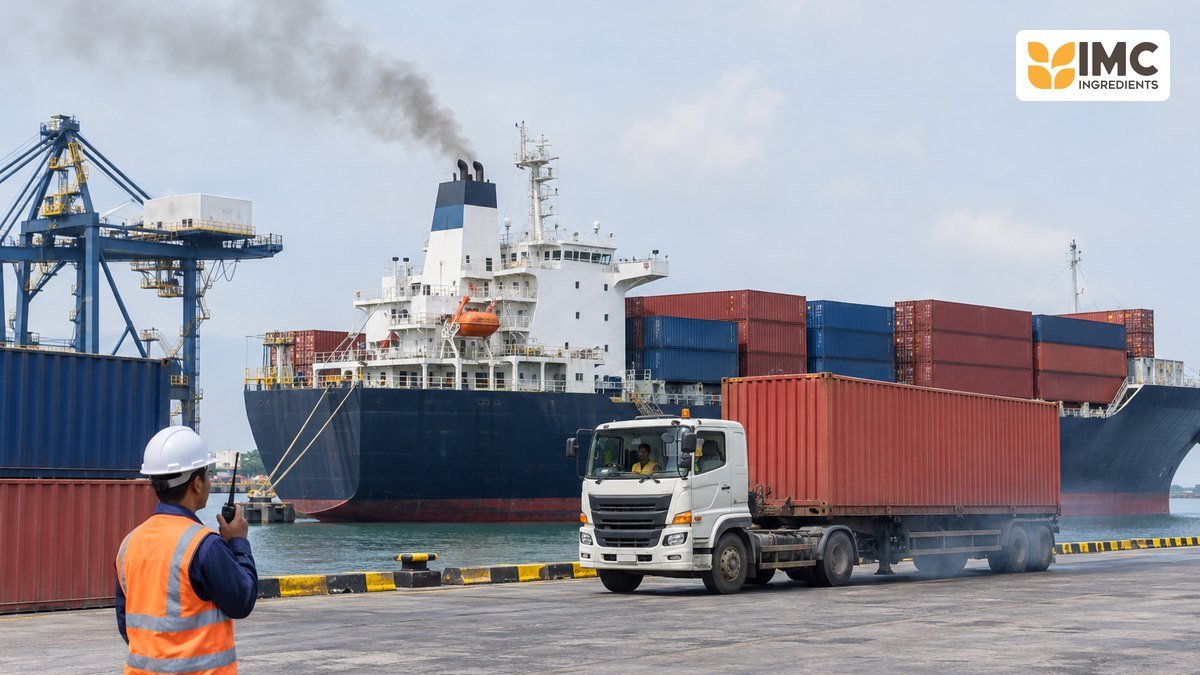
Quick answer: Transporting food ingredients creates greenhouse gas emissions. Sea freight in containers is generally one of the lowest-emission ways to move goods long distances per tonne-kilometre, compared with air freight. Buyers and suppliers can reduce transport emissions by using full containers, efficient routes, good planning and fewer urgent shipments by air.
Key takeaways – Emissions depend on mode, distance and load. – Sea freight is usually far lower per tonne-km than air freight. – Full containers and good planning reduce emissions per tonne. – Inland transport also matters.
How transport emissions are estimated
Emissions are often estimated using distance, weight and an emission factor for each transport mode. Results are expressed in kilograms of CO2-equivalent per tonne-kilometre. Methods such as the GLEC Framework help standardise these estimates. Values vary by vessel type, route and data source.
Comparing modes
| Mode | Relative emissions per tonne-km |
|---|---|
| Air freight | Very high |
| Road truck | Medium to high |
| Rail | Low to medium |
| Sea freight (container ship) | Low |
These are general comparisons; actual numbers depend on many factors.
Why sea freight is efficient
Large container ships carry thousands of containers at once, spreading fuel use over a large cargo. For dry, stable ingredients like coconut sugar, sea freight is the normal mode.
Practical ways to reduce impact
- Fill containers fully and efficiently.
- Plan orders to avoid urgent air shipments.
- Choose efficient routes and carriers.
- Use rail for inland legs where available.
- Combine shipments where possible.
Inland transport
Trucking from factory to port and from port to warehouse can contribute significantly, especially over long distances. Efficient loading and route planning help.
Data requests from buyers
Some buyers ask suppliers for transport emission estimates as part of their climate reporting. Suppliers can share shipment details such as weight, distance, mode and container type, and use recognised calculation methods.
Claims
Avoid claims such as “carbon neutral shipping” unless supported by robust, verified methods. Describe actual measures instead.
Packaging and load efficiency
Packaging affects how much product fits in each container. Strong bags that stack well and pallet patterns that use space efficiently increase payload. Removing unnecessary packaging layers reduces weight. These steps lower emissions per tonne of product and can also reduce freight cost, giving both environmental and business benefits.
Sharing data with buyers
When buyers request transport data, suppliers can provide a simple table for each shipment: origin, port of loading, port of discharge, container type, net weight and transport mode for each leg. Buyers can then apply their chosen calculation method. Keeping this data organised makes it easy to respond to climate reporting requests.
Where does IMC fit?
PT Integral Mulia Cipta (IMC Group) has produced coconut sugar in Central Java, Indonesia, since 2012. IMC ships organic and conventional coconut sugar in mesh 14 and mesh 50 to buyers abroad by sea freight.
FAQ
Is sea freight low-emission? It is generally much lower per tonne-km than air freight.
How are emissions calculated? Using distance, weight and mode-specific factors.
How can emissions be reduced? Full containers, good planning and efficient routes.
Can shipping be called carbon neutral? Only with robust, verified methods.
Questions about coconut sugar for your products? PT Integral Mulia Cipta (IMC Group), a Central Java producer since 2012, is happy to help. Email info@organic-coconut-sugar.com or WhatsApp +62 821 1348 5564.