
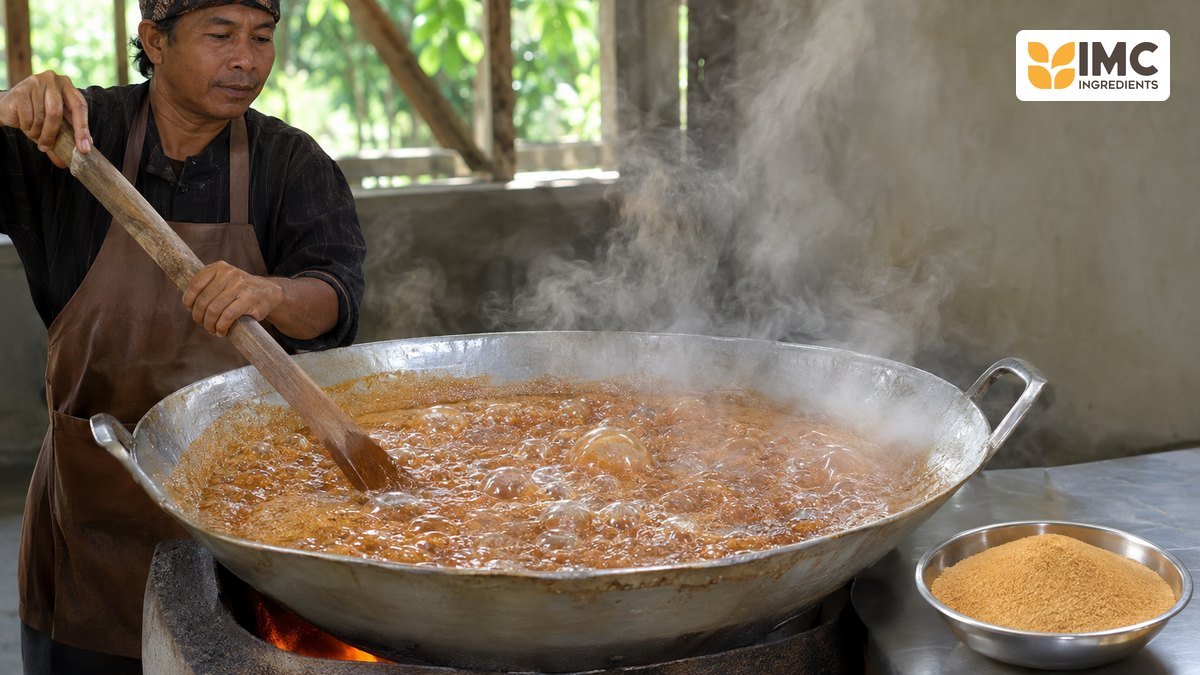
Quick answer: Fresh coconut sap is mostly water with dissolved sugars. During cooking, most of that water evaporates as steam, concentrating the sugars until a thick syrup forms. Stirring as it cools turns the syrup into granules with only a small amount of moisture left. Controlling how much water remains is key to free-flowing, stable sugar.
Key takeaways – Sap is mostly water; sugar is mostly dry solids. – Cooking evaporates most of the water. – The boiling point rises as sugar concentrates. – Final moisture affects flow, clumping and shelf life.
Starting point: sap
Fresh coconut sap is a clear, sweet liquid. Most of it is water, with sugars, mainly sucrose, and small amounts of other components dissolved in it. Many litres of sap are needed to make one kilogram of sugar, because so much water must be removed.
Evaporation during cooking
| Stage | Water status | Appearance |
|---|---|---|
| Fresh sap | Mostly water | Clear, thin |
| Early boiling | Water evaporating | Foaming, light colour |
| Mid cooking | Concentration rising | Golden, thicker |
| Late cooking | Little water left | Thick, amber syrup |
| Granulation | Very little water | Granules form |
Boiling point rise
Pure water boils at around 100 degrees Celsius at sea level. As sugar concentration increases, the boiling point rises. Producers use this, along with visual signs, to judge when syrup is ready. A thermometer can help make this more consistent.
Why stop at the right point
If cooking stops too early, too much water remains. The syrup may not granulate well, and granules may be sticky and clump. If cooking goes too far, the sugar can darken excessively or burn. The right end point balances moisture, colour and flavour.
Moisture in granules
After granulation, a small amount of moisture remains. Further drying may be used to reach a target. Specifications usually set a maximum moisture, because higher moisture increases clumping and can affect shelf life.
After packing
Sugar is hygroscopic and can absorb water from humid air. Moisture-protective packaging, like paper bags with a food-grade PE liner, and dry storage help keep moisture low.
Energy use
Evaporating so much water needs a lot of heat. Efficient stoves and pans can reduce fuel use, saving costs for farmers and reducing smoke.
Water in the rainy season
In the rainy season, rainwater can enter sap containers if they are not covered. This dilutes the sap, so more water must be boiled away, using more fuel and time. Covering containers and checking them after rain helps. Humid air also slows drying of finished sugar, making careful storage even more important during wet months.
Where does IMC fit?
PT Integral Mulia Cipta (IMC Group) has produced coconut sugar in Central Java, Indonesia, since 2012. IMC supplies organic and conventional coconut sugar in mesh 14 and mesh 50, packed in paper bags with a food-grade PE liner.
FAQ
Is coconut sap mostly water? Yes, with dissolved sugars.
Why does the boiling point rise? Because sugar concentration increases.
What happens if cooking stops too early? Sugar may be sticky and clump.
How is moisture kept low after packing? With moisture-protective packaging and dry storage.
IMC Group (PT Integral Mulia Cipta) supplies fine-granule organic coconut sugar from Central Java to food companies worldwide. Talk to our team: info@organic-coconut-sugar.com or WhatsApp +62 821 1348 5564.