
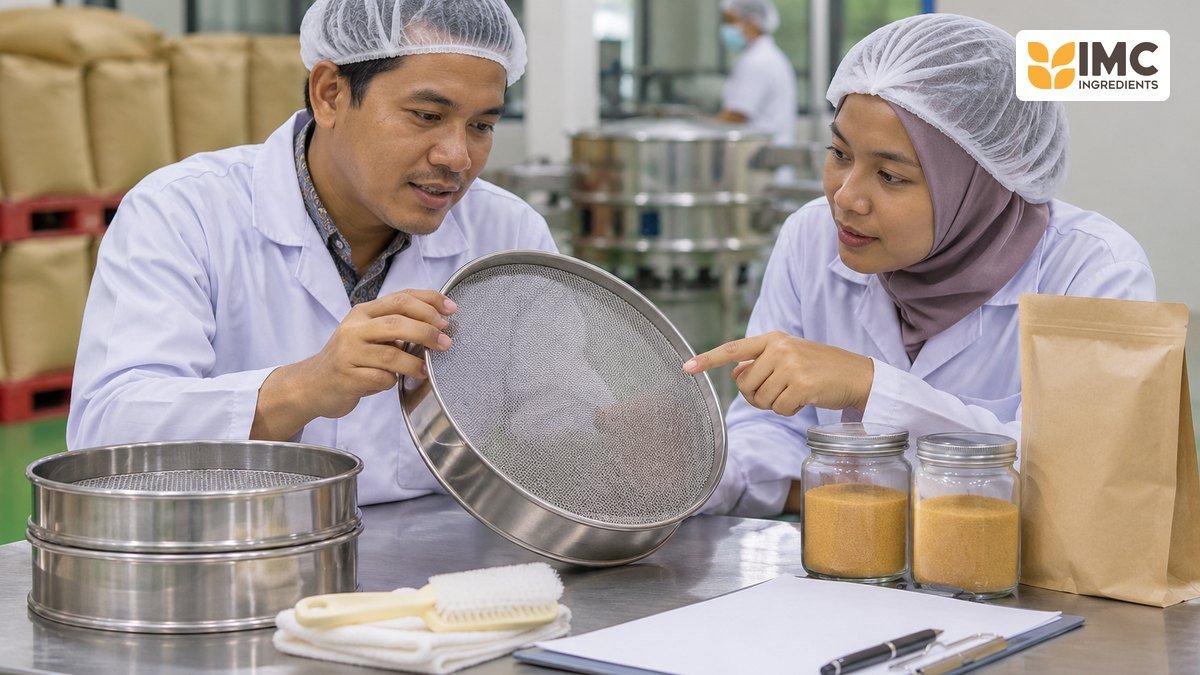
Quick answer: Sieve mesh screens control the particle size of coconut sugar and remove oversized pieces and foreign matter. They must be inspected before and after each shift, cleaned regularly and replaced when damaged. A torn screen can let lumps or foreign material into the product, so sieve checks are an important food safety control.
Key takeaways – Sieves set particle size, such as mesh 14 or mesh 50. – They also remove lumps and foreign matter. – Inspect screens before and after use. – Record checks and replace damaged screens.
What mesh numbers mean
Mesh number describes how many openings a screen has per inch. A higher mesh number means smaller openings and finer sugar. Mesh 14 gives a coarse sugar, while mesh 50 gives a fine one. Using the right screen is the basis of a consistent product.
Roles of the sieve
| Role | Why it matters |
|---|---|
| Particle size control | Meets customer specification |
| Lump removal | Better flow and dissolving |
| Foreign matter removal | Product safety |
| Process check | Damaged screen signals a problem |
Inspection routine
- Check the screen before the shift starts.
- Look for tears, holes, loose edges and stretched mesh.
- Check the frame and seals.
- Check again at the end of the shift.
- Record results with time and signature.
If a screen is found damaged at the end of a shift, the product sieved since the last good check should be held and assessed.
Cleaning
Remove sugar residue with dry brushing where possible. If water cleaning is needed, dry the screen completely before use, as moisture causes sugar to stick and clog the mesh. Follow the cleaning schedule and use food-safe tools only.
Handling tailings
Material that stays on top of the screen is called tailings. Check tailings for foreign matter. They can show problems in drying or cooling, such as large lumps. Record findings and handle tailings according to the factory’s procedure.
Spare screens and replacement
Keep spare screens of each mesh size in clean storage. Replace screens on a schedule or as soon as damage is found. Label screens clearly so the wrong mesh is not fitted by mistake.
What buyers can ask
Buyers can ask how sieve checks are done, how often screens are inspected and what happens when damage is found. These questions are common in supplier audits.
Training operators
Operators must know how to fit, check and clean each screen. A short training with photos of good and damaged screens helps staff spot problems quickly. Supervisors check records daily to make sure inspections are done on time.
Where does IMC fit?
PT Integral Mulia Cipta (IMC Group) has produced coconut sugar in Central Java, Indonesia, since 2012. IMC sieves its coconut sugar to mesh 14 and mesh 50, including organic, and packs it in paper bags with a food-grade PE liner.
FAQ
What does mesh 50 mean? A fine screen with about 50 openings per inch.
How often should screens be checked? Before and after each shift.
What happens if a screen is torn? The affected product is held and assessed.
How are screens cleaned? Mostly dry brushing; any wet cleaning must be fully dried.
Looking for a reliable coconut sugar partner? Contact PT Integral Mulia Cipta (IMC Group) in Central Java, Indonesia: info@organic-coconut-sugar.com or WhatsApp +62 821 1348 5564.