
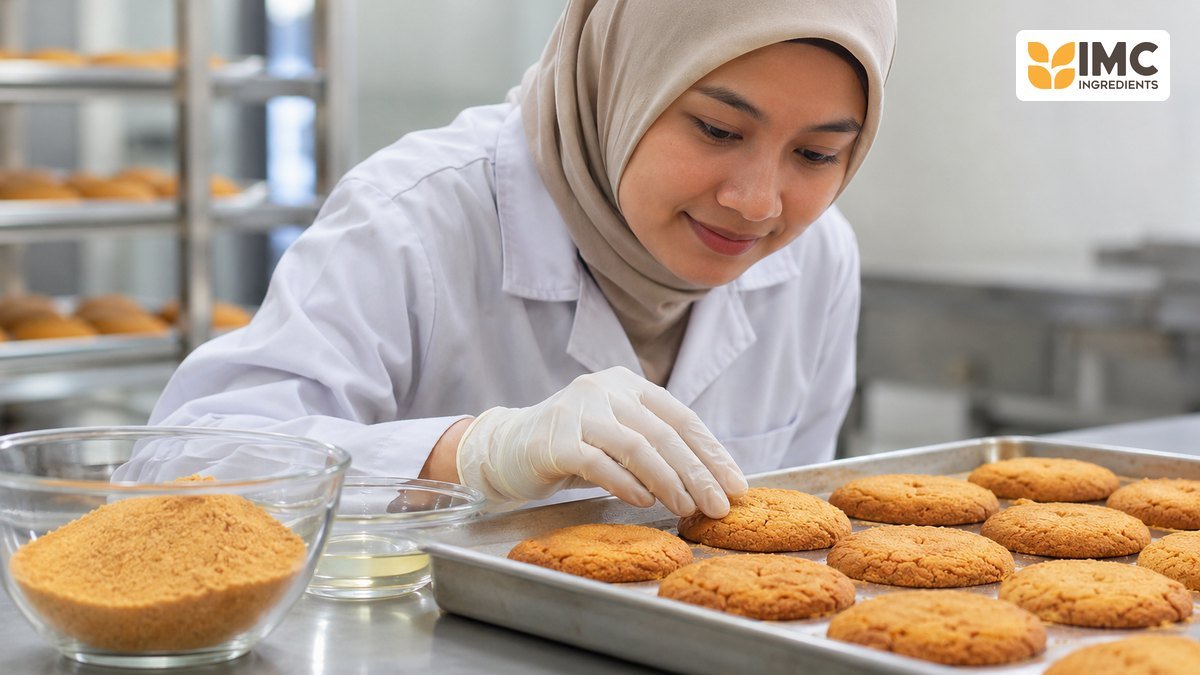
Quick answer: Coconut sugar products often brown faster than those made with refined white sugar, because coconut sugar starts brown and contains small amounts of reducing sugars that speed up Maillard reactions. Formulators can control browning through baking temperature and time, pH, sugar blends and protein levels.
Key takeaways – Coconut sugar adds colour before and during baking. – Reducing sugars speed up browning reactions. – Temperature, time and pH are the main levers. – Blending with other sugars can lighten colour.
Why coconut sugar browns faster
- It already has a light to medium brown colour.
- It contains small amounts of glucose and fructose, which are reducing sugars.
- Reducing sugars react with proteins and amino acids during heating.
Main browning reactions
| Reaction | What happens |
|---|---|
| Maillard reaction | Sugars react with amino acids, creating colour and flavour |
| Caramelisation | Sugars break down at high heat |
Both reactions increase with temperature and time.
Levers for control
- Temperature: lower oven or fryer temperatures slow browning.
- Time: shorter baking reduces colour.
- pH: more acidic conditions slow Maillard browning; alkaline conditions speed it up.
- Protein: high milk or egg protein increases browning.
- Sugar blend: combining coconut sugar with refined sucrose reduces colour.
- Moisture: very dry surfaces brown faster.
Practical examples
- Cookies too dark at the edges: lower temperature, use lighter trays.
- Cake tops too dark: lower temperature, cover lightly near the end.
- Fried snacks too dark: check frying temperature and coating sugar level.
- Cereal coatings too dark: reduce toasting time or temperature.
Using baking soda carefully
Baking soda raises pH and can increase browning. If formulas with coconut sugar become too dark, review leavening levels.
Browning during storage
Products can continue to darken slowly during storage, especially in warm conditions. Check colour over shelf life and use cooler storage or packaging that limits oxygen and moisture if needed.
Measuring colour
Use colour charts, simple image comparison or a colorimeter to measure browning consistently. Record results for each test batch.
When browning is wanted
Browning is not always a problem. In biscuits, crackers and bakery coatings, the deeper colour and roasted notes from coconut sugar can be a selling point. The goal is control, not removal, so the product looks the same from batch to batch.
Where does IMC fit?
PT Integral Mulia Cipta (IMC Group) has produced coconut sugar in Central Java since 2012. IMC supplies mesh 50 and mesh 14 coconut sugar with specifications that help formulators plan colour in finished products.
FAQ
Why do coconut sugar products brown faster? Because of natural colour and reducing sugars.
How can I reduce browning? Lower temperature, shorten time, lower pH or blend sugars.
Does baking soda affect browning? Yes. It raises pH and increases browning.
Can products darken in storage? Yes, slowly; test over shelf life.
IMC Group (PT Integral Mulia Cipta) supplies fine-granule organic coconut sugar from Central Java to food companies worldwide. Talk to our team: info@organic-coconut-sugar.com or WhatsApp +62 821 1348 5564.