
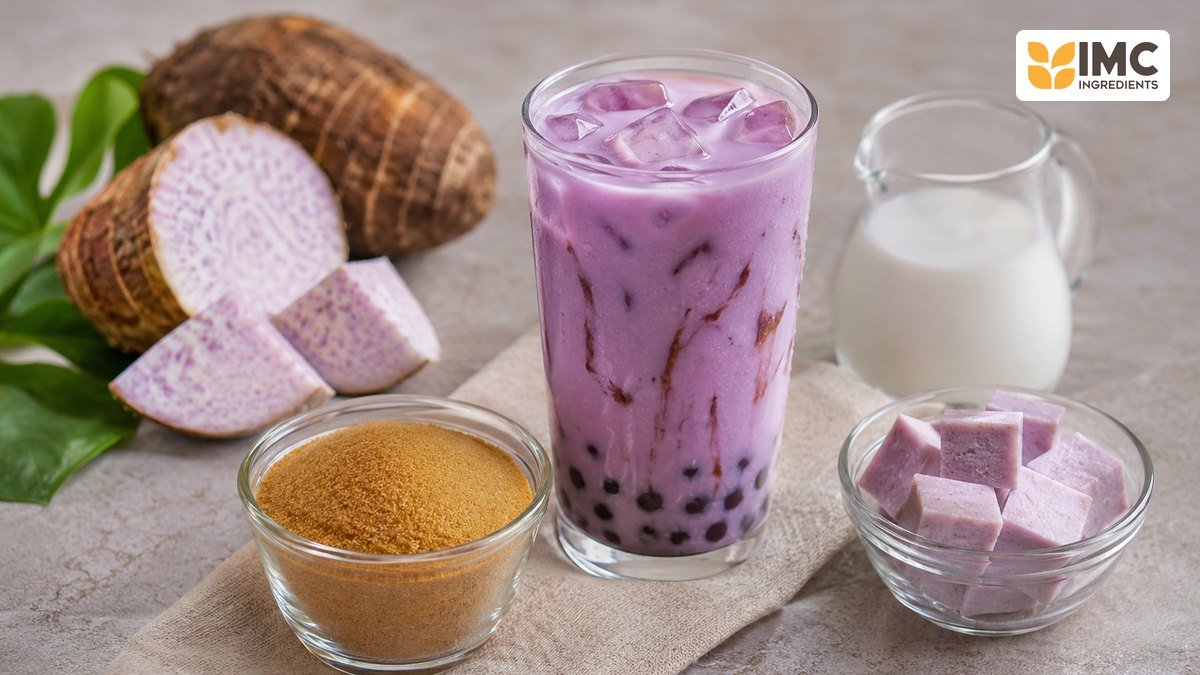
Quick answer: Coconut sugar sweetens taro drinks well when used as a syrup. Its caramel notes pair with the nutty, vanilla-like flavour of taro. Because coconut sugar is brown, it can shift the lilac colour of a taro drink towards beige, so many cafés use a partial swap or add the syrup as a visible layer.
Key takeaways – Use coconut sugar as a syrup for cold drinks. – It pairs well with taro’s nutty flavour. – It may change the drink’s lilac colour. – Layering can turn colour into a feature.
Why taro drinks are popular
Taro drinks are a favourite in bubble tea shops and cafés. They are made with taro paste, taro powder or cooked taro, blended with milk or plant milk and ice. The drinks are creamy, mildly sweet and often lilac in colour.
Ways to use coconut sugar
| Method | Effect |
|---|---|
| Coconut sugar syrup mixed in | Caramel sweetness, beige tint |
| Partial swap with white syrup | Keeps more lilac colour |
| Syrup layer on glass wall | Visual stripes, flavour contrast |
| Sweetened taro paste | Sweetness built into the base |
| Sugar rim with mesh 14 | Crunch and decoration |
Making the syrup
Dissolve mesh 50 coconut sugar in hot water at 1:1 or 2:1 by weight. Stir without boiling hard, cool and store in a clean bottle in the refrigerator. A rich 2:1 syrup is easier to dose in small amounts.
Building the drink
- Add taro paste or powder to the cup or shaker.
- Add the coconut sugar syrup dose.
- Add milk or plant milk and ice.
- Shake or blend until smooth.
- Add toppings such as tapioca pearls.
Colour considerations
If the lilac colour is part of the brand, start with a partial swap, such as half coconut sugar syrup and half white syrup. Another option is to swirl coconut sugar syrup on the inside of the cup before adding the drink. The brown stripes look attractive and keep the taro colour visible.
Sweetening taro paste
Some shops make their own taro paste by mashing cooked taro with sugar and milk. Coconut sugar can sweeten the paste directly. Cook gently, as sugar can scorch at the bottom of the pan.
Consistency for chains
Write the syrup ratio and dose on every recipe card. Use pumps for exact dosing. Check sweetness with a refractometer if you produce syrup centrally for several outlets.
Hot taro drinks
Coconut sugar also suits hot taro lattes. Add the syrup to the hot milk and stir well before pouring. In hot drinks, granulated mesh 50 coconut sugar can be used directly, as it dissolves quickly in warm liquid.
Where does IMC fit?
PT Integral Mulia Cipta (IMC Group) has produced coconut sugar in Central Java, Indonesia, since 2012. IMC supplies fine mesh 50 coconut sugar for syrups, as well as mesh 14 and organic options, to beverage and café businesses.
FAQ
Does coconut sugar suit taro? Yes, its caramel notes pair with taro’s nutty flavour.
Will the drink lose its lilac colour? It can; use a partial swap or a syrup layer.
What syrup ratio is best? 1:1 or 2:1 by weight.
Can I sweeten taro paste with it? Yes, cook gently to avoid scorching.
Questions about coconut sugar for your products? PT Integral Mulia Cipta (IMC Group), a Central Java producer since 2012, is happy to help. Email info@organic-coconut-sugar.com or WhatsApp +62 821 1348 5564.