
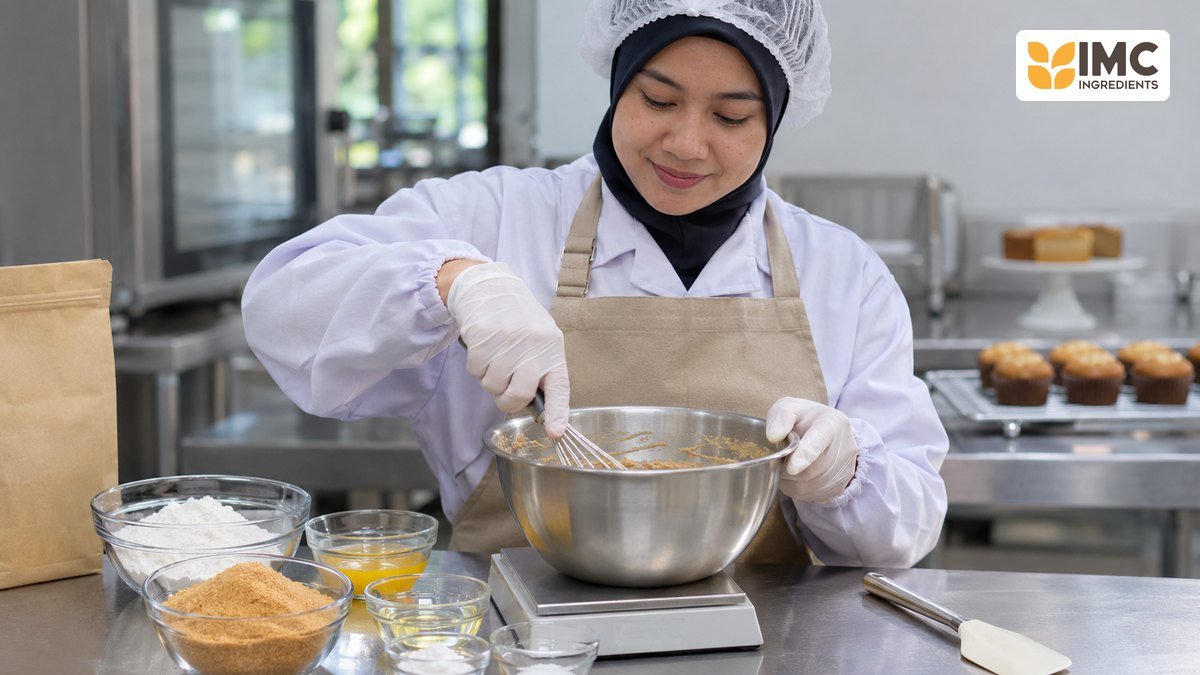
Quick answer: Coconut sugar is mostly sucrose, so it can replace white or brown sugar 1:1 by weight in many formulas. The main differences are colour, caramel flavour, a slightly higher tendency to absorb moisture and sometimes faster browning. Start with mesh 50, change one variable at a time and test the product over its full shelf life.
Key takeaways – Coconut sugar behaves much like sucrose in most formulas. – Expect darker colour and caramel notes. – Moisture and browning need attention. – Test systematically and over shelf life.
What formulators need to know
Coconut sugar is made by cooking coconut blossom sap, crystallising it and drying it. Published analyses report sucrose at roughly 70 to 79 percent, with smaller amounts of glucose, fructose and natural minerals. Its brown colour and caramel taste come from the cooking process.
Key properties for formulation
| Property | What it means for formulas |
|---|---|
| Sweetness | Similar to sucrose; taste test to confirm |
| Colour | Light to medium brown |
| Flavour | Caramel, toffee, light molasses |
| Moisture uptake | Higher than refined white sugar |
| Browning | Can be faster due to reducing sugars |
| Particle size | Mesh 14 coarse, mesh 50 fine |
Choosing the grade
Mesh 50 suits most formulations because it dissolves and blends easily. Mesh 14 is better for toppings or where visible granules are wanted. For chocolate and smooth spreads, mesh 50 is usually refined further.
Step-by-step approach
- Define the target: flavour, colour, texture, cost and label.
- Make a control batch with your current sugar.
- Replace sugar 1:1 by weight with coconut sugar.
- Keep all other ingredients and process settings the same.
- Compare colour, taste, texture and processing behaviour.
- Adjust one variable at a time.
- Run shelf life tests on the best version.
Common adjustments
- Lower baking temperature slightly to control browning.
- Adjust liquid if dough or batter consistency changes.
- Increase flavour pairings such as vanilla, cocoa or spices.
- Use moisture-barrier packaging for dry products.
Partial replacement
A partial swap, such as 25 or 50 percent, keeps a lighter colour while adding some caramel notes. This works well for products that must stay fairly pale.
Labelling basics
Use the ingredient name accepted in your market, usually “coconut sugar”. It counts as added sugar in many markets. Organic claims require certification. Avoid health claims unless approved.
Working with your supplier
Ask your supplier for a specification, a certificate of analysis per lot and typical nutrition data. Share your application so the supplier can recommend a grade. Keep a reference sample from the lot used in development.
Scaling up from lab to plant
Results in the lab do not always match production. Before launch, run at least one pilot or production trial with the final equipment, mixing times and ovens. Check how coconut sugar flows through hoppers and dosing systems, and confirm colour and texture on full-size batches.
Where does IMC fit?
PT Integral Mulia Cipta (IMC Group) has produced coconut sugar in Central Java, Indonesia, since 2012. IMC supplies mesh 14 and mesh 50 coconut sugar, including organic, to food manufacturers, with specifications and lot documents for development teams.
FAQ
Can coconut sugar replace sucrose 1:1? By weight, yes, in many formulas.
Which grade should I start with? Mesh 50.
What changes most? Colour, flavour and sometimes browning speed.
Should I test shelf life? Yes, always with the final formula and packaging.
PT Integral Mulia Cipta (IMC Group) has produced organic coconut sugar in Central Java, Indonesia, since 2012. For specifications or samples, email info@organic-coconut-sugar.com or WhatsApp +62 821 1348 5564.