
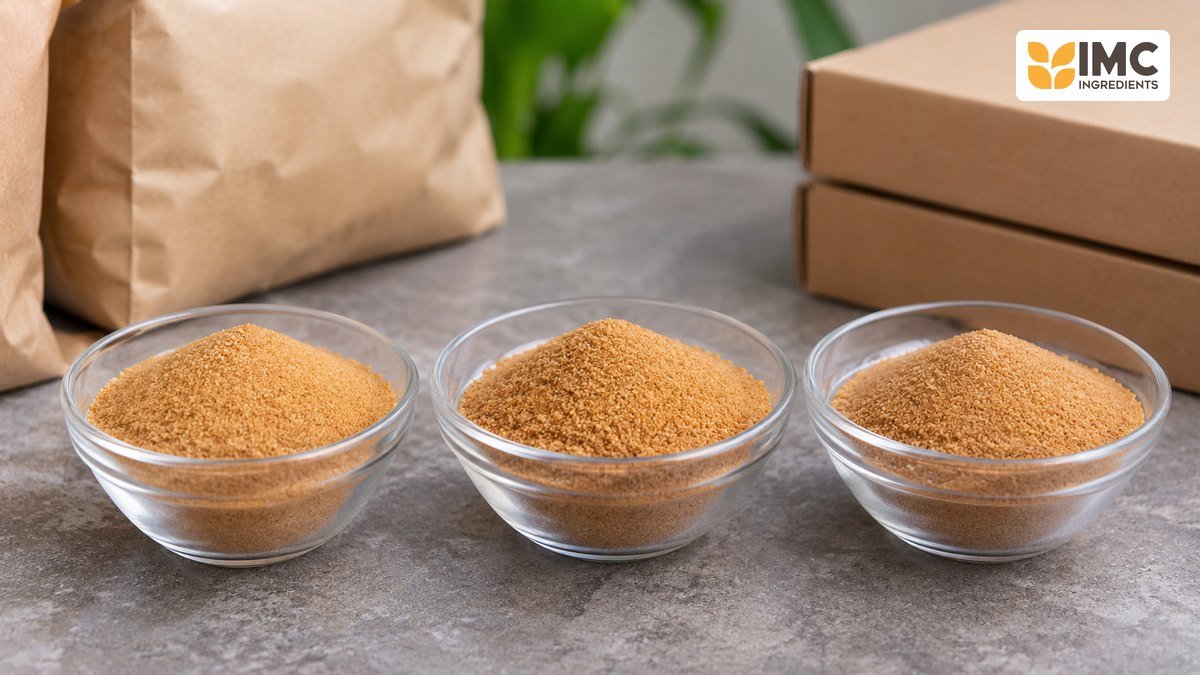
Quick answer: Coconut sugar is a minimally processed natural product, so colour, moisture and flavour can vary a little from batch to batch. Differences come from the sap, the season, cooking time, drying and sieving. Clear specifications, sampling and lot testing keep these differences within agreed limits for food manufacturers.
Key takeaways – Small natural variation is normal. – Sap, season and cooking affect colour and flavour. – Drying and sieving affect moisture and particle size. – Specifications and testing keep batches within range.
Why a natural product varies
Coconut sugar is made by collecting sap from coconut blossoms, cooking it until it thickens, then crystallising and drying it. It is not refined like white sugar, which is purified until almost only sucrose remains. Because coconut sugar keeps more of the natural compounds from the sap, small differences in the raw material show in the final product.
Main sources of variation
| Factor | What it can change |
|---|---|
| Sap freshness | Colour and flavour |
| Season and weather | Sap composition |
| Cooking time and heat | Colour depth, caramel notes |
| Drying | Moisture content, flowability |
| Sieving | Particle size distribution |
| Storage | Clumping, colour over time |
Colour differences
Colour is the variation buyers notice first. Longer cooking or higher heat gives a darker product. In finished foods with strong colours, such as chocolate or spiced baked goods, small colour differences hardly matter. In pale products, a buyer may want a tighter colour range.
Moisture and flow
Moisture affects how freely the sugar flows and how well it stores. Good drying and sealed packaging help keep moisture low. Lots that are slightly higher in moisture may clump more easily in humid conditions.
How suppliers control variation
- Agreed specifications for moisture, colour, particle size and microbiology.
- Standard cooking and drying steps.
- Sieving to the agreed mesh size.
- Sampling and testing each lot.
- Lot coding so every bag can be traced.
- Retained samples for later comparison.
What buyers can do
Share the parameters that matter most for your product. Approve a reference sample and compare new lots against it. Check the lot documents on arrival. For colour-sensitive products, test a small trial batch with each new lot before full production.
Blending to reduce differences
Some factories blend production lots before packing to even out small differences. Buyers who use large volumes can also rotate stock so that one lot is used fully before the next starts. This makes any change easier to notice and manage on the production line.
Talking about variation with customers
If you sell a finished product, a small colour difference between production runs is normal for a natural ingredient. Many brands explain this simply on their website or in customer service replies. Honest, factual wording helps customers understand without making claims the product cannot support.
Where does IMC fit?
PT Integral Mulia Cipta (IMC Group) has produced coconut sugar in Central Java, Indonesia, since 2012. IMC supplies mesh 14 and mesh 50 coconut sugar, including organic, with lot coding and documents so food manufacturers can manage batch-to-batch consistency.
FAQ
Is batch variation a quality problem? Not when it stays within the agreed specification.
What varies most? Usually colour and moisture.
How can I manage colour in pale products? Agree a colour range and test each new lot.
Can I keep a reference sample? Yes, a reference sample is a useful comparison tool.
IMC Group (PT Integral Mulia Cipta) supplies fine-granule organic coconut sugar from Central Java to food companies worldwide. Talk to our team: info@organic-coconut-sugar.com or WhatsApp +62 821 1348 5564.